Latest News
📅 May 7, 2026
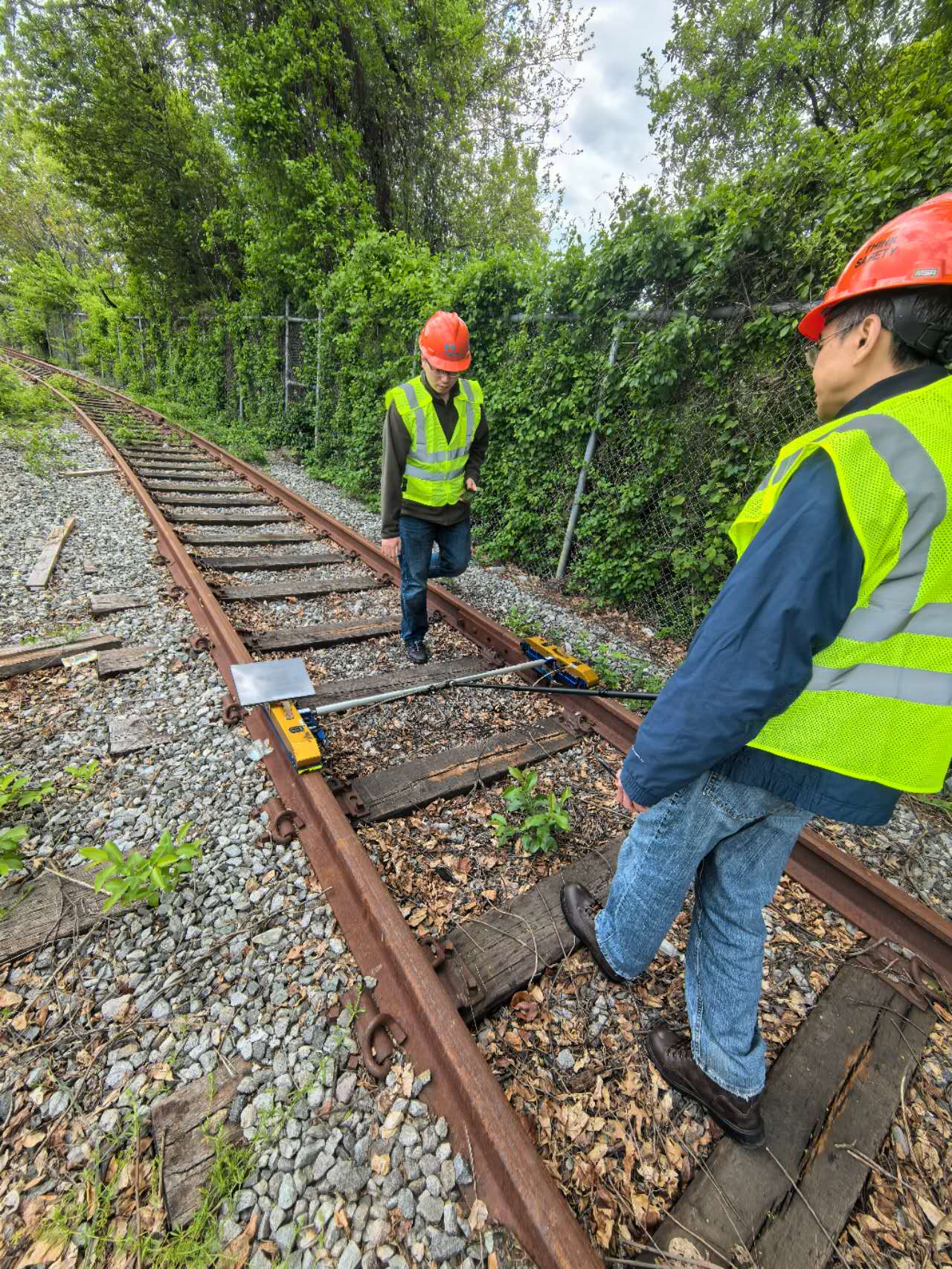
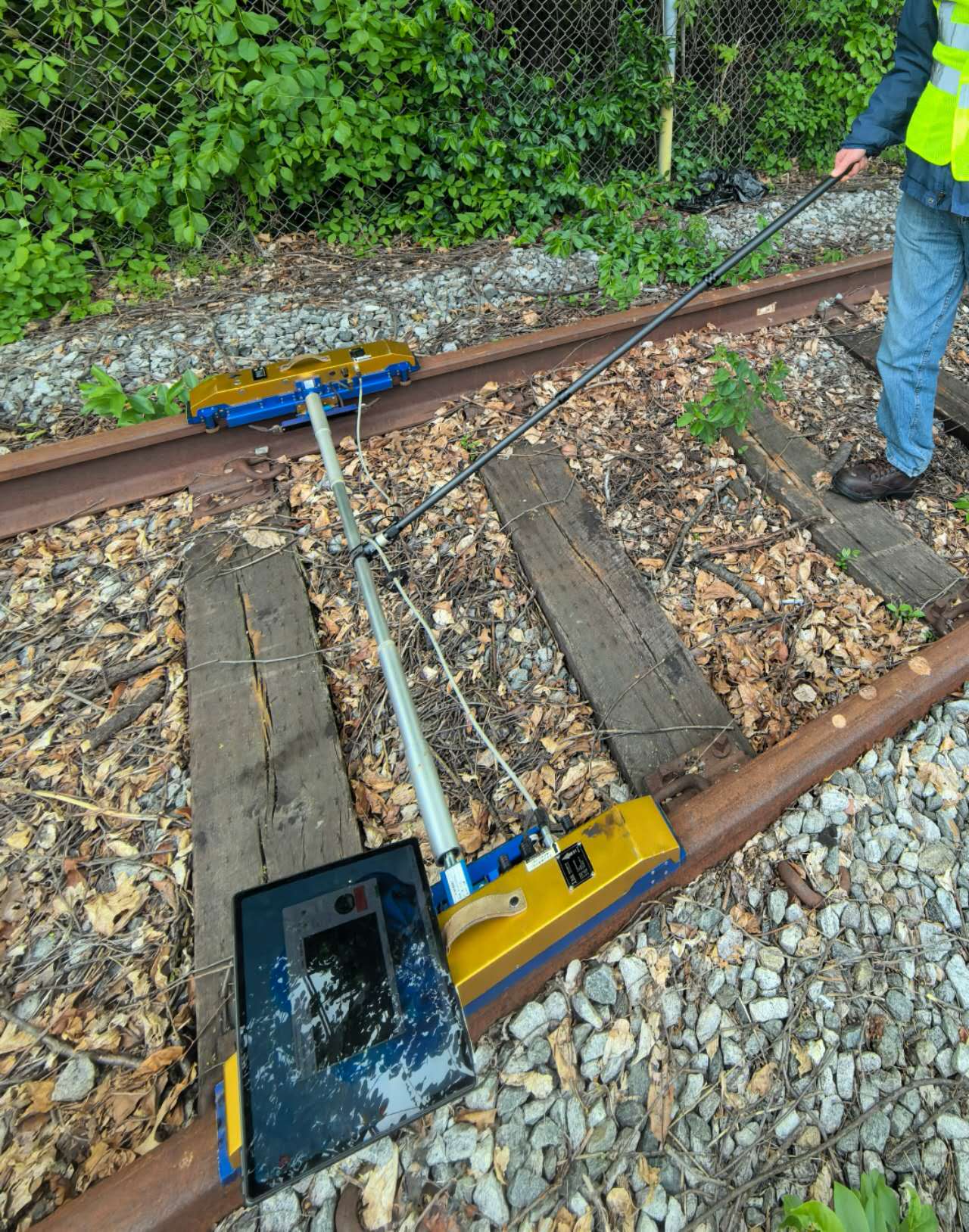
🚆 Track Inspection Field Test with a Transit Rail Company
INTIS Lab collaborated with a transit rail company to conduct field testing on rail track corrugation and weld conditions. The team collected measurement data to better understand track surface irregularities, weld performance, and potential safety concerns. This collaboration supports the development of data-driven rail infrastructure assessment methods, helping improve maintenance planning, strengthen track reliability, and promote safer railway operations for passengers, workers, and surrounding communities across the regional network through continuous research and innovation.
January 2026
Study on Deterioration Mechanism of Concrete Bridge Decks Based on Survival Analysis
The research was presented as a poster at the Transportation Research Board (TRB) 2026 Annual Meeting in Washington, DC. The study applies survival analysis to investigate the deterioration process of concrete bridge decks and demonstrates how National Bridge Inventory data can support infrastructure condition assessment.
The presentation highlighted a data-driven approach for understanding deterioration mechanisms, estimating service-life patterns, and informing long-term bridge maintenance and rehabilitation planning.
December 2025
Risk-Based Highway Transportation Infrastructure Management
Prof. Yun Bai presented this research at the Bruce Podwal Seminar at the City College of New York (CCNY). The seminar introduced a risk-based framework for highway transportation infrastructure management that connects asset condition, hazard exposure, failure consequences, and economic impacts.
The talk also discussed how transportation agencies can use quantitative risk information to prioritize maintenance and resilience investments, compare intervention strategies, and support transparent long-term capital planning.
📅 November 2025
🛰️ PhD Student Chenglue Huang presents poster at NJIT GSA

Poster: Deep Residual Network-Based Detection of Train Acoustic Warning Signals
PhD Student Chenglue Huang presented a poster at the NJIT Graduate Student Association forum, showcasing a lightweight, customized ResNet for real-time detection of train horns and bells. The work addresses a key gap in rail-grade crossing safety: acoustic warnings often provide the earliest signal when visibility is poor, yet legacy detectors struggle with short, high-noise events. Trained on 900+ hours of field audio from the Greater Boston area, the model leverages log–mel spectrograms, focal loss, and SpecAugment to stay robust amid traffic, crowd noise, and weather. By enabling low-latency, edge-ready acoustic sensing, the approach complements camera-based systems and strengthens multimodal monitoring for rail safety and intelligent infrastructure.
📅 October 2025
🚄 Track inspection project with Rutgers CAIT
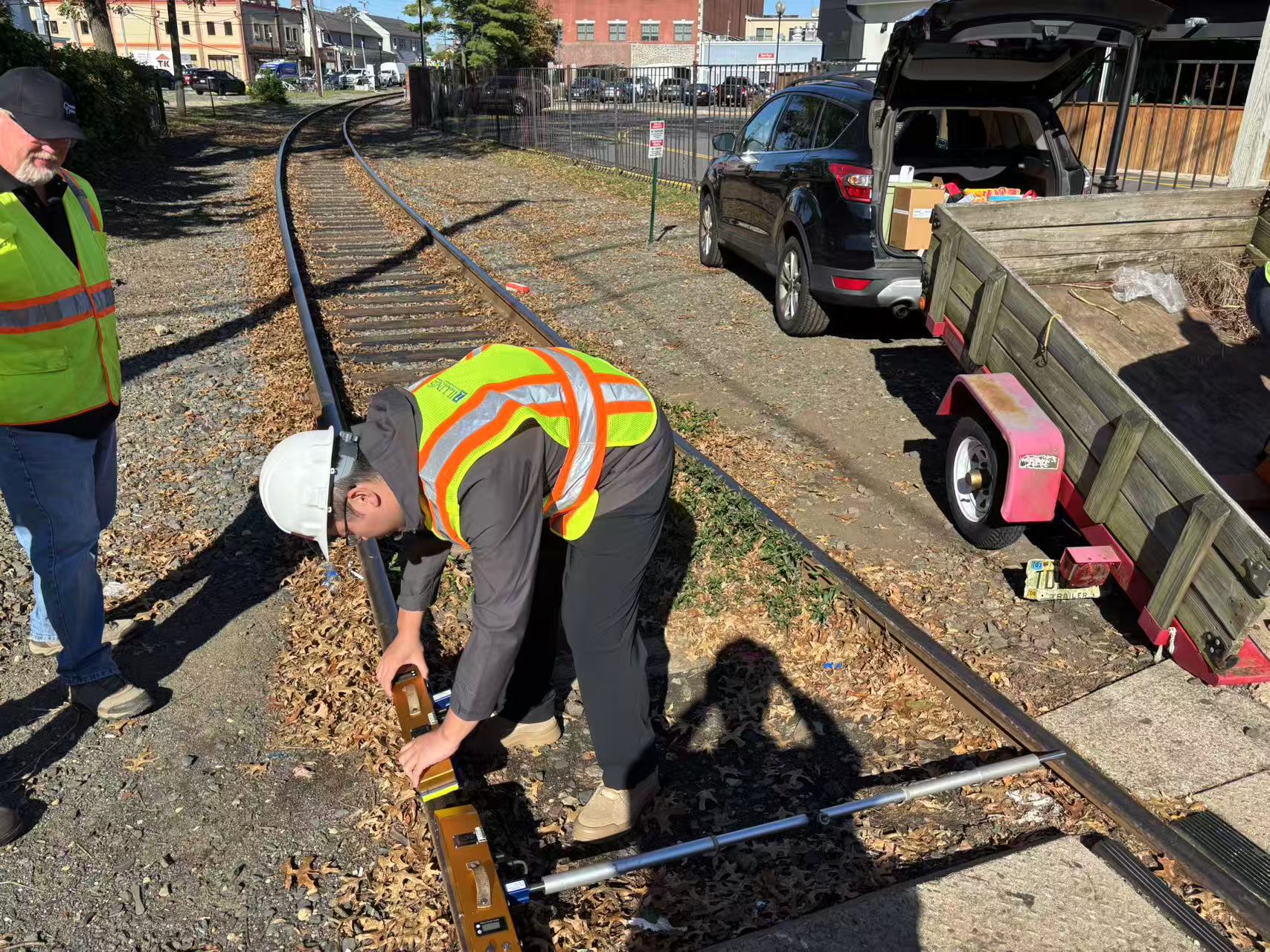
INTIS Lab is collaborating with Rutgers CAIT on a rail track inspection initiative headquartered at 18 Throckmorton St, Freehold, NJ 07728. The team is deploying multi-sensor data collection (vision, vibration, and acoustic sensing) alongside AI-driven defect detection to assess rail integrity, joint conditions, and ballast health.
The project will produce a repeatable inspection workflow that fuses field data with historical maintenance logs to prioritize interventions, reduce inspection cycles, and inform capital planning. Early pilots are guiding a scalable toolkit for agencies to enhance safety, resilience, and cost-effective maintenance across regional rail corridors.
July 2025
Railway Side Slope Hazard Detection System Based on Generative Models
The research was presented at the 25th COTA International Conference of Transportation Professionals in China. The work explores the use of generative models for detecting hazards along railway side slopes from visual data.
The presentation described an AI-assisted monitoring workflow designed to improve the identification of potentially unsafe slope conditions and support more efficient railway inspection and risk screening.
June 2025
Methodology and Tool Development for Maritime Asset Management: Multi-Year Planning for Optimal Navigation Channel Dredging and Dredged Material Management
The work was presented orally at the World Dredging Congress & Exposition 2025 in San Diego, California. The presentation introduced methodology and decision-support tools for coordinating navigation channel dredging activities over multiple years.
The research considers dredging requirements, project timing, material placement alternatives, and management constraints to support more strategic and cost-effective maritime asset planning.
January 2025
Efficient Lightweight Railway Track Segmentation Network for Resource-Constrained Platforms with TensorRT
The research was presented orally at the Transportation Research Board (TRB) 2025 Annual Meeting in Washington, DC. The work focuses on an efficient railway track segmentation network designed for deployment on resource-constrained computing platforms.
The presentation discussed model optimization with TensorRT and the importance of lightweight computer vision for practical, low-latency railway inspection and monitoring applications.
January 2025
Onboard Metro Train Localization Based on the Train Motion and Track Geometry Features Fusion
The research was presented as a poster at the Transportation Research Board (TRB) 2025 Annual Meeting in Washington, DC. The study investigates onboard metro train localization through the fusion of train-motion information and track-geometry features.
The proposed approach supports more reliable train positioning in rail environments where satellite-based localization may be unavailable or insufficient for operational needs.